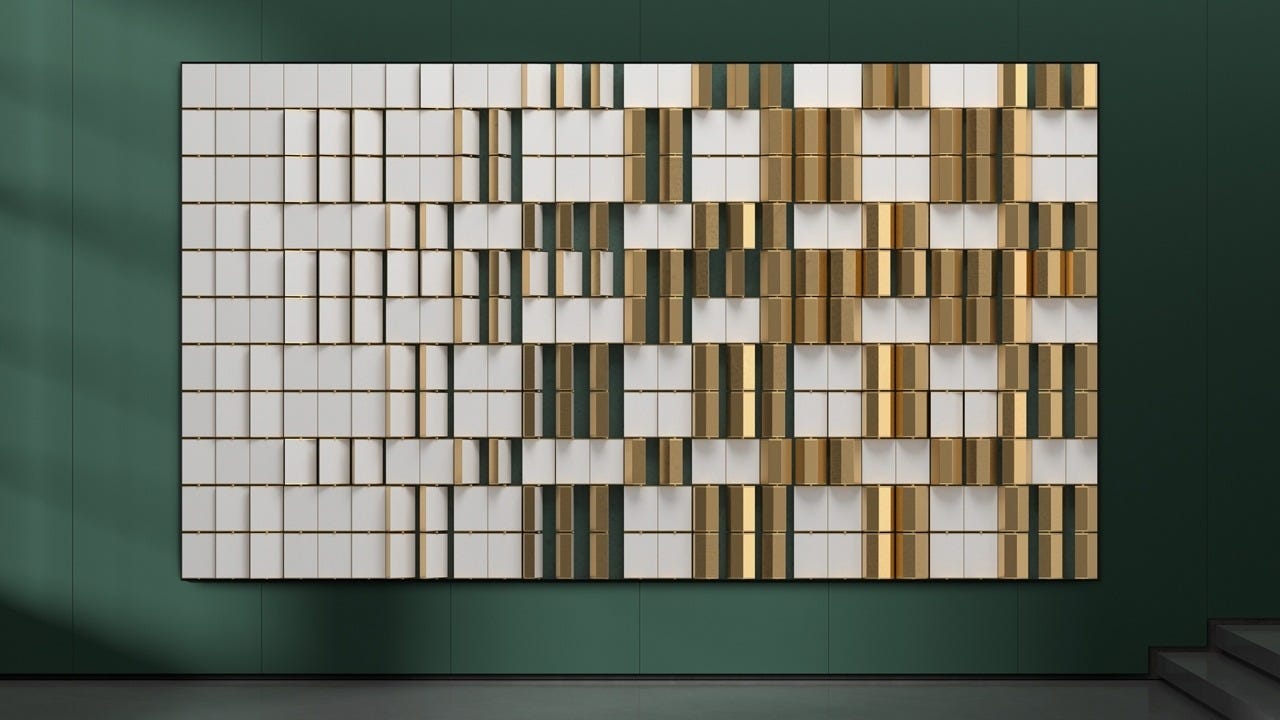
In this Futurespaces talk, Cedric Kiefer—Co-Founder and Creative Director of the Berlin-based studio onformative—describes what it means to design experiences in a moment when our tools are changing faster than our habits. His fascination with science and computation informs projects ranging from media façades and public installations to AI-driven research.
For Kiefer, embracing uncertainty in times of constant change isn’t a risk to be managed away, but a creative stance. He treats algorithms, datasets, and AI agents not as magic shortcuts, but as collaborators that surface new perspectives—on cities, on materials, on the tools we use and the stories we tell.
If you missed the live talk, this article recaps the key ideas and takeaways for experience designers working at the edge of art and technology.
From Generative Design to Experience Systems
onformative emerged out of generative design—a practice rooted in using code, data, and algorithms as creative materials. The studio was founded 16 years ago by Kiefer and his partner Julia Laub, shortly after co-publishing a book on generative design.
“The idea was always to use code and technology to be creative—to express yourself using algorithms and data.”
That early work set a tone they’ve never really left behind. Today, onformative is a creative innovation studio shaping new perspectives by combining art, design, and technology. The team’s research-driven approach leads to intentional, impactful experiences that prioritize human-centered concepts, visual clarity, and long-term behavior over short-term spectacle. Their practice spans four broad areas:
Experiential communication and spatial installations
Generative systems and AI-driven narratives
Humanizing technology and interface design
Strategic innovation and artistic research
Kiefer resists the idea that they’re simply in the “beautiful image-making business.” Aesthetics matter, but only in service of intention and process.
“There was always a reason behind why we do certain things—and a strong focus on how we do it.”
For experience designers navigating a shifting technological landscape, this commitment to intent and process becomes a recurring anchor in his work.
Rather than a greatest-hits reel, Kiefer’s projects read like a series of controlled experiments: what happens when you treat a lobby, a media wall, or a phone screen as a living system instead of a static frame? Each commission starts with a simple question, then uses code and data to stretch that question into a behavior.
ANIMA iki: Letting Visitors Write the Script
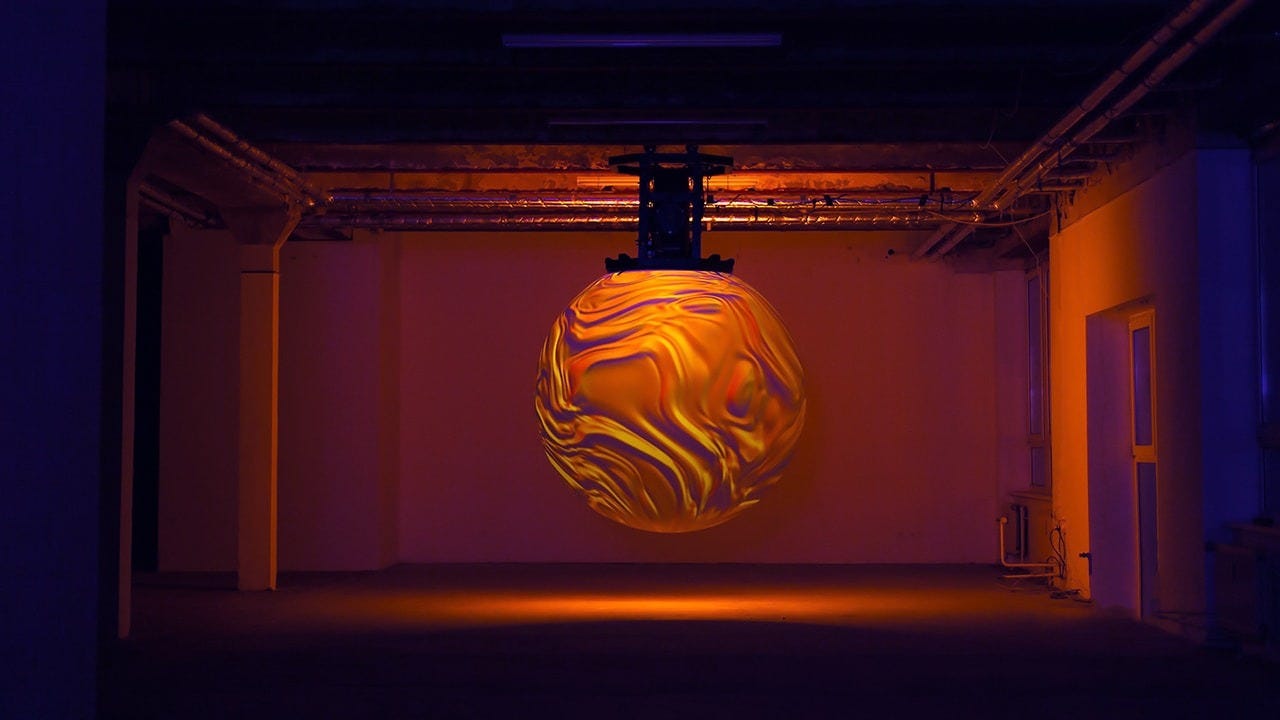
In ANIMA iki, onformative distills a lot of its thinking about behavior and perception into a single, larger-than-life object: a two-meter orb suspended in a darkened room, the only source of light. Fluid, metallic patterns shimmer across its surface while tones swell and recede in the space. As visitors enter, speak, or move, the sphere and the soundscape shift in response, creating a feedback loop between bodies, sculpture, and environment.
“We never told anyone how to interact with it,” Kiefer notes. “In each city, people used it differently.”
Rather than explaining how any of this works, the studio lets people figure it out. Some circle the orb cautiously; others test it with claps, whispers, or movement. Over time, ANIMA takes on a kind of life of its own—an entity that “forages” in its surroundings, remediating what it senses into light and sound. The piece becomes both an immersive experience and a quiet study in how audiences negotiate an intelligent, reactive presence in space.
Dolby Lobby: Visualizing Immersion
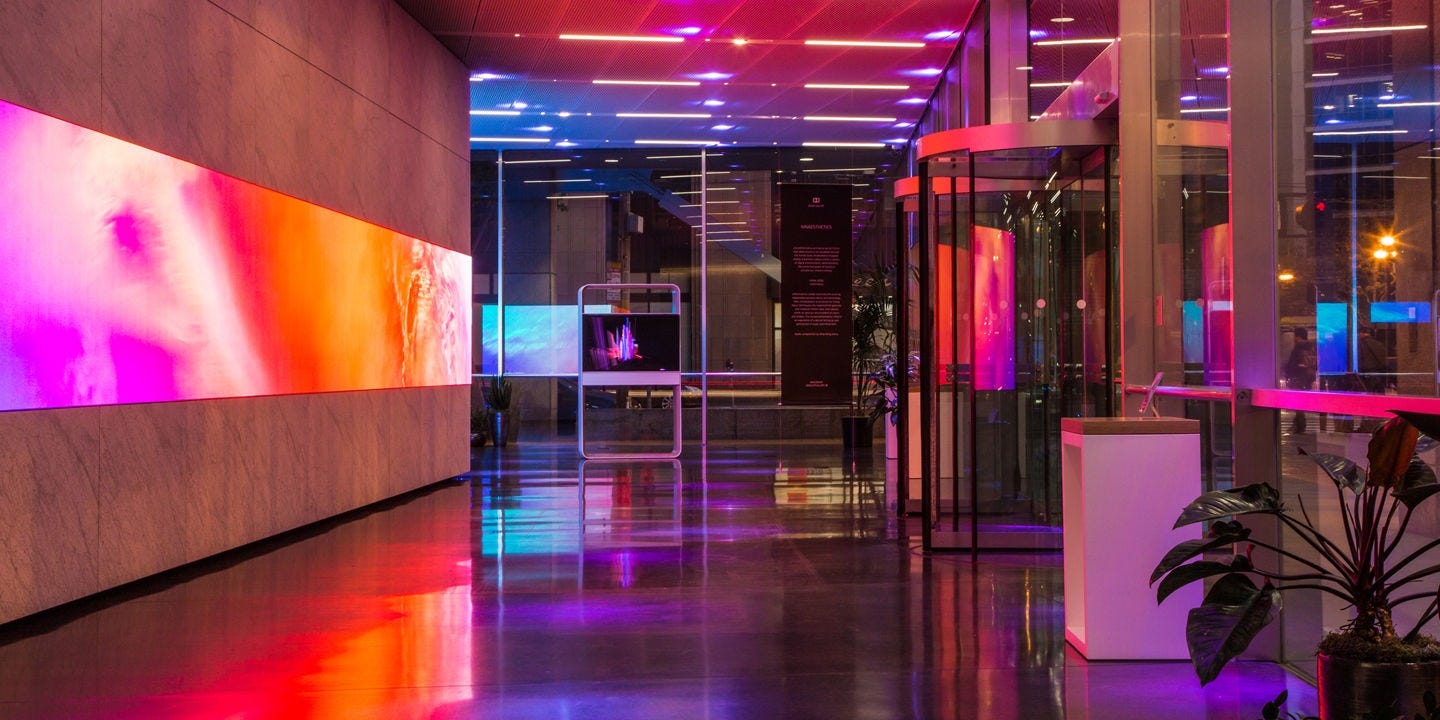
At Dolby’s San Francisco headquarters, onformative was asked to create content for a massive LED wall paired with a 64-speaker sound array. The brief could have yielded a glossy, cinematic brand film. Instead, Kiefer’s team treated the wall as a window into the feeling of deep creative focus.
They recorded motion data from dancers and athletes and transformed those movements into abstract forms that swirl and collide across the screen—occasionally hinting at human silhouettes before dissolving again.
“We saw it as a way to show what it feels like to be completely immersed in the creative process.”
The resulting installation, Collide, is a real-time visual environment that responds to music and motion, examining how technology reframes our experience of both.
The soundscape was created with musicians performing inside that abstract world, reacting live to the visuals in a spatial audio setup. The work isn’t there to decorate a lobby or simply “show off” Dolby’s technology—it turns the space into a laboratory for sensing how art, sound, and digital image collide, in real time, around the people in the room.
AT&T Knowledge Archive: Turning an Archive into a Landscape
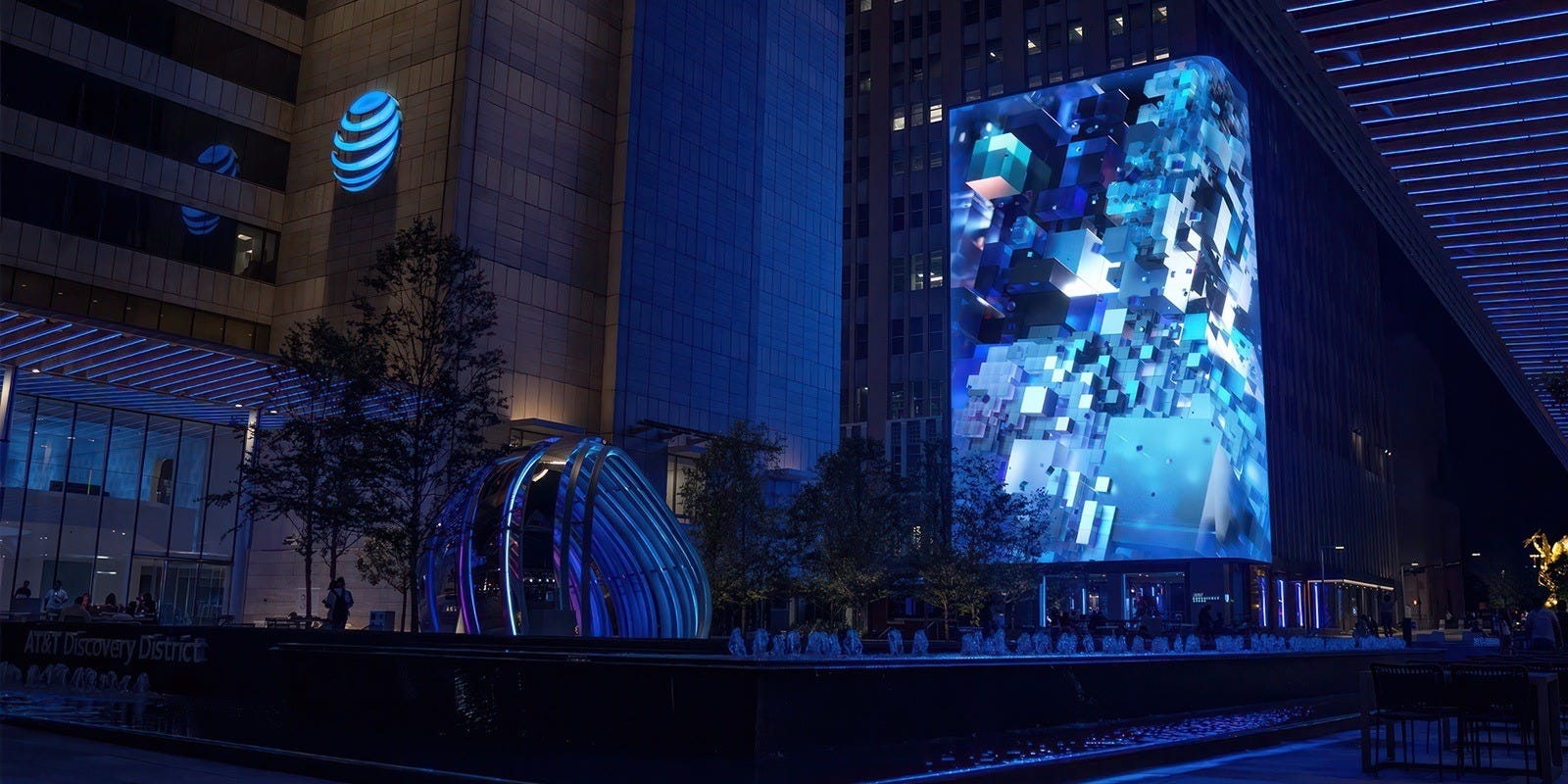
For AT&T’s global headquarters in downtown Dallas, the Discovery District, onformative was asked to give form to a familiar but slippery idea: modern connectivity. The canvas is hard to miss—a 104-foot-tall exterior media wall that anchors the plaza.
The resulting one-hour piece, Data Cloud, treats that façade less as a billboard and more as a living diagram of the networks we carry around in our pockets. Inspired by the vast amounts of data that move through our phones each day, the work turns flows of information into shifting, abstract formations that swell, disperse, and recombine across the surface.
Rather than illustrate devices or signals literally, Data Cloud leans into atmosphere. It visualizes the beauty and complexity of an always-on networked world—the invisible systems that route our messages, media, and calls—without spelling any of it out. For passersby in the plaza, the piece becomes a kind of weather system for connectivity, a quiet reminder that the “cloud” is not somewhere else, but moving constantly around and between them.
Shanghai: Seeing a City as a System
The project that earned an audible “ooh” from the Futurespaces audience was a commission in Shanghai. Asked to make a piece “about the city,” Kiefer’s team skipped the skyline and tourist landmarks and went looking for structure instead: street grids, building facades, the repeating patterns you only really notice from a distant window or a satellite image.
Those patterns became the raw material for a generative system. Geospatial data drives shifting compositions of lines, planes, and light that continuously assemble and disassemble across a large-scale display. By day, the work reads as a restrained play of architecture, density, and shadow; by night, it tips toward the neon intensity most people associate with Shanghai, without ever resorting to literal depiction.
As with Data Cloud, the piece doesn’t explain itself. It simply behaves—letting passersby feel the city as a living, pulsing system rather than a fixed postcard view. For experience designers, it’s a neat demonstration of Kiefer’s core move: use data not to illustrate a place, but to reveal the hidden logic that’s already there.
Process: Designing Behavior, Not Just Content
Across these projects, Kiefer keeps returning to the same move: shift the design focus from what it looks like to how it behaves over time.
That shift is especially visible in onformative’s long-running collaboration with Samsung. Over almost a decade, the studio has created dozens of real-time visual “modes” for TVs, micro-LED walls, and phones—artworks that sit in people’s homes, offices, and pockets.
Some pieces adjust subtly with local weather; others respond to audio in the room. Wallpapers quietly evolve based on how and when the device is used. The point isn’t constant spectacle, but a slow, almost domestic kind of responsiveness.
Because onformative handles the full stack—from concept to code running on devices—they can design at the level of logic:
What inputs shape this piece?
How should it react to change?
When should it rest?
For experience designers used to handing off motion boards or static compositions, Kiefer’s practice is a reminder that in real-time environments, the “story” often lives in the rules, not the frames.
Working with AI: Co-Creation, Not One-Click Magic
Kiefer is clear-eyed about AI. He’s less interested in “type a prompt, get a picture” than in what happens when you invite machine learning into the process as a collaborator.
In one project, the studio became fascinated by satellite imagery of meandering rivers. Instead of animating a pretty landscape, they built simulations of water flow, erosion, and sediment. Over time, the river’s movement “draws” a landscape—an evolving record of force and time.
The music for the piece was created through a feedback loop between humans and machine learning: pianists improvised to the visuals, those recordings trained a model, and the AI’s variations were then edited and arranged by the team. The result feels neither purely human nor purely synthetic.
For Kiefer, this is the future-facing pattern:
Humans set direction, define constraints, and curate.
Algorithms propose variations and unexpected paths.
The work lives in the negotiation between the two.
He compares it to historical studios where master artists worked with teams of assistants. The tools have changed; the questions about authorship and judgment haven’t.
Takeaways for Experience Designers
So what does all of this look like when translated into day-to-day practice? Kiefer’s work suggests a handful of concrete moves for experience designers working with emerging tech:
1. Treat technology as material, not message. Instead of starting with “What can this new screen or AI model do?”, start with the question or behavior you care about. Let the tech follow the idea, not the other way around.
2. Design systems, not just moments. Think in terms of rules, inputs, and behaviors. How should this piece change over a day, a season, a program cycle? What does “idle” look like? What does “attention” look like?
3. Leave room for people to discover. Like ANIMA iki consider where you can resist over-explaining. A little ambiguity can invite play, experimentation, and local interpretation.
4. Show the traces of process. Whether in a sculptural AI experiment or a data-driven visualization, don’t be afraid to let people see the “tool marks”: glitches, paths, and hints of how the system works. It can deepen trust and curiosity.
5. Use AI as a collaborator, not a vending machine. Let models suggest options, combinations, and perspectives you wouldn’t arrive at alone—but keep human taste and judgment in the loop. The interesting work lives in how you respond, not what the model spits out.
Author’s Note
This article was developed by Futurespaces based on Cedric Kiefer’s live presentation and follow-up materials. Unlike many of our sessions, we weren’t able to host a live conversation or Q&A with Kiefer this week. We’re nonetheless deeply grateful for his time and the care he brought to sharing onformative’s practice with the Futurespaces community.
For those with follow-up questions or ideas, Kiefer has invited you to reach out directly via his LinkedIn.
This article was developed by Futurespaces based on Cedric Kiefer’s live talk and and our notes from the conversation. t’s part of an ongoing editorial series tracing how artists, designers, and technologists are rethinking experience design in an age of intelligent systems and shifting tools. We host presentation and conversations like this every Thursday — we’d love to have you join us!